world of shattered isles
A fractured alien world of red-grey rock floats beneath a colossal purple-and-gold planet, its deep chasms choked with toxic blue smoke. Constant earthquakes have forced life to stay low, light, and adaptable, with homes carved into the stone and no tall structures. Small blue inhabitants cross the broken terrain through bridges, cable cars, and narrow paths, creating a fragile civilisation built on movement, resilience, and survival.
A small, unstable planet suspended beneath an enormous purple-and-gold celestial body, this world is defined by fracture, isolation, and adaptation.
Above hangs the defining presence of a gigantic purple planet streaked with hints of gold. It appears impossibly close, dominating the sky and dwarfing the fractured world beneath it. Its scale gives the landscape an almost surreal sense of vulnerability, making every house, bridge, and inhabitant feel tiny against the larger universe.
The atmosphere is perpetually moody. Thick clouds and drifting smoke soften the horizon, while deep shadows fill the gorges and warm amber light leaks from homes carved into the stone. The contrast between the purple-gold sky, red-grey terrain, toxic blue mist, and glowing settlements creates a world that feels both dangerous and strangely intimate.
At its core, this is a civilisation built around survival through adaptation.
Nothing here is monumental. Nothing is permanent.
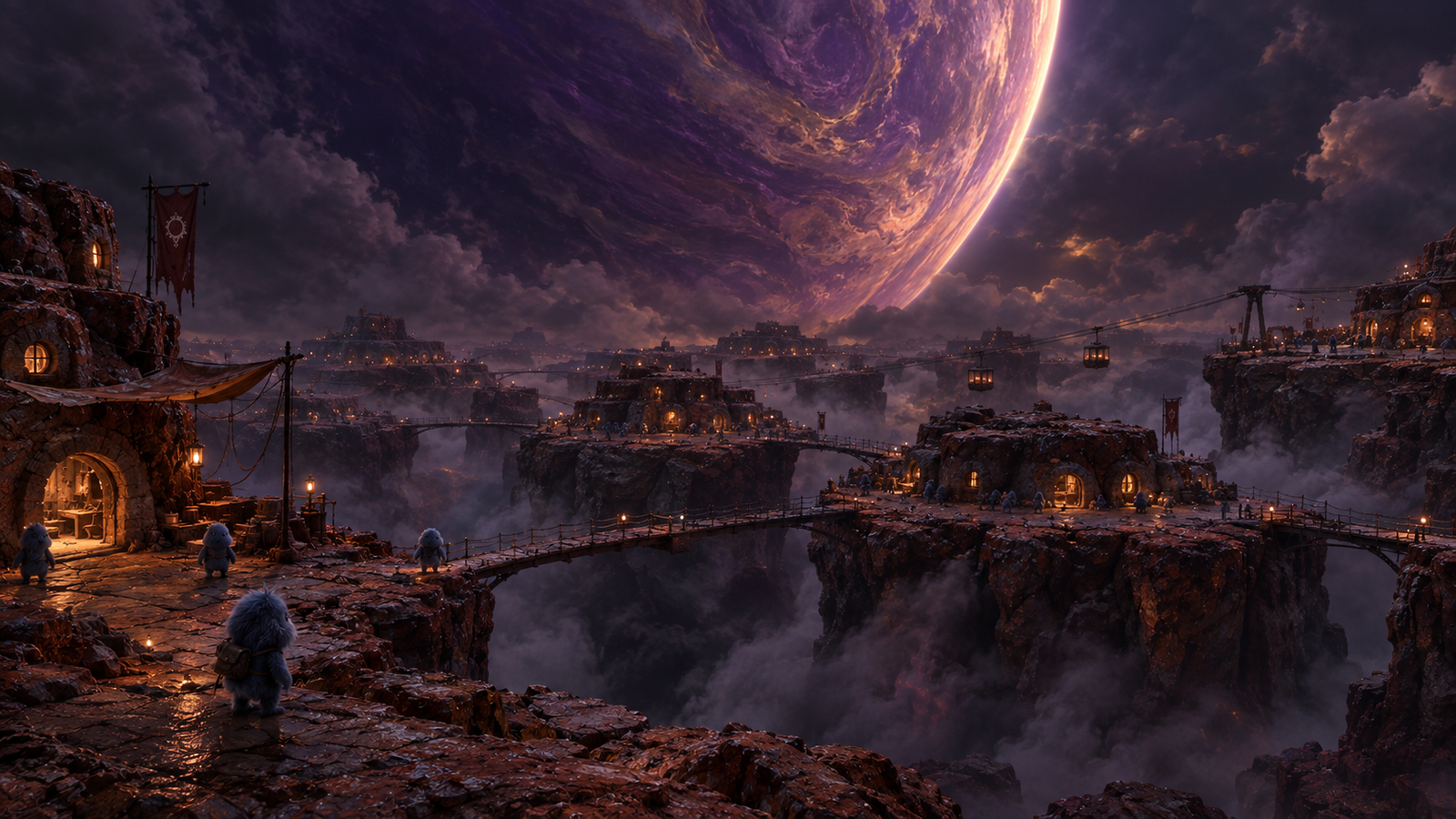
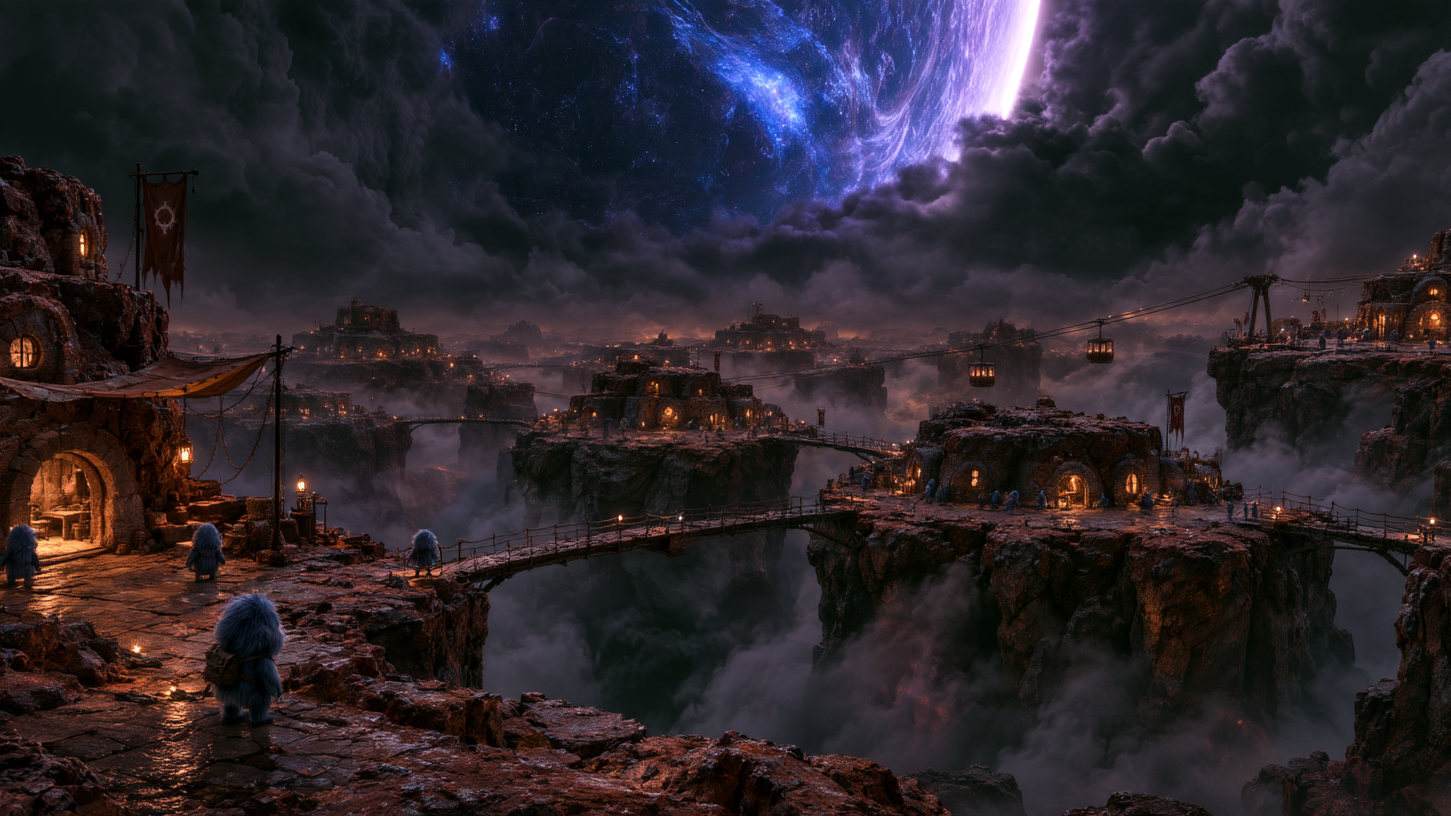
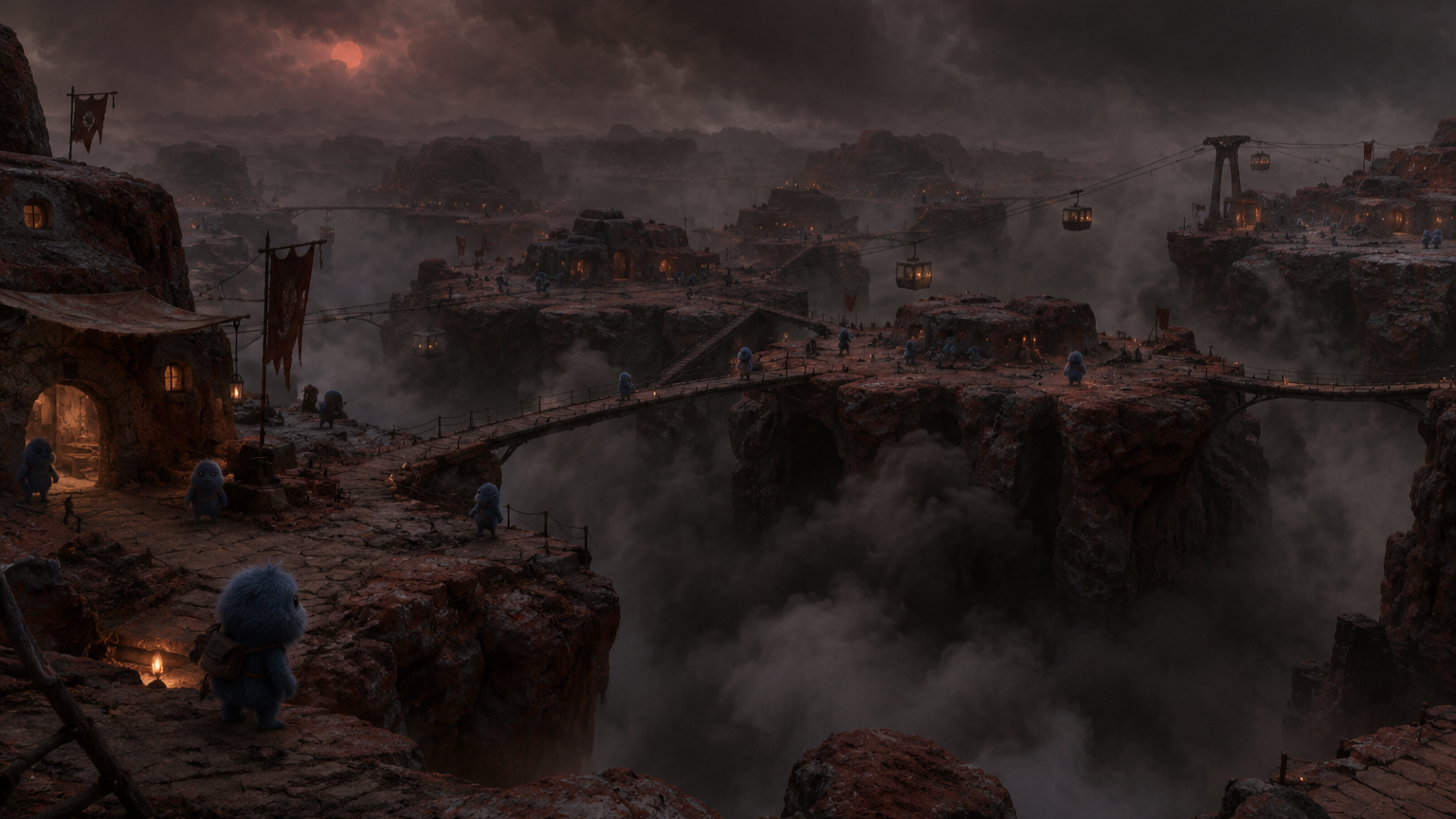
The planet is geologically violent. Constant earthquakes have split its surface into hundreds of rocky plateaus and fragmented land masses, leaving behind vast gorges filled with dense, toxic blue-grey smoke. Because the ground is never truly stable, no tall structures exist here. Every settlement is low, compact, and embedded directly into the rock, designed to survive repeated tremors rather than resist them.
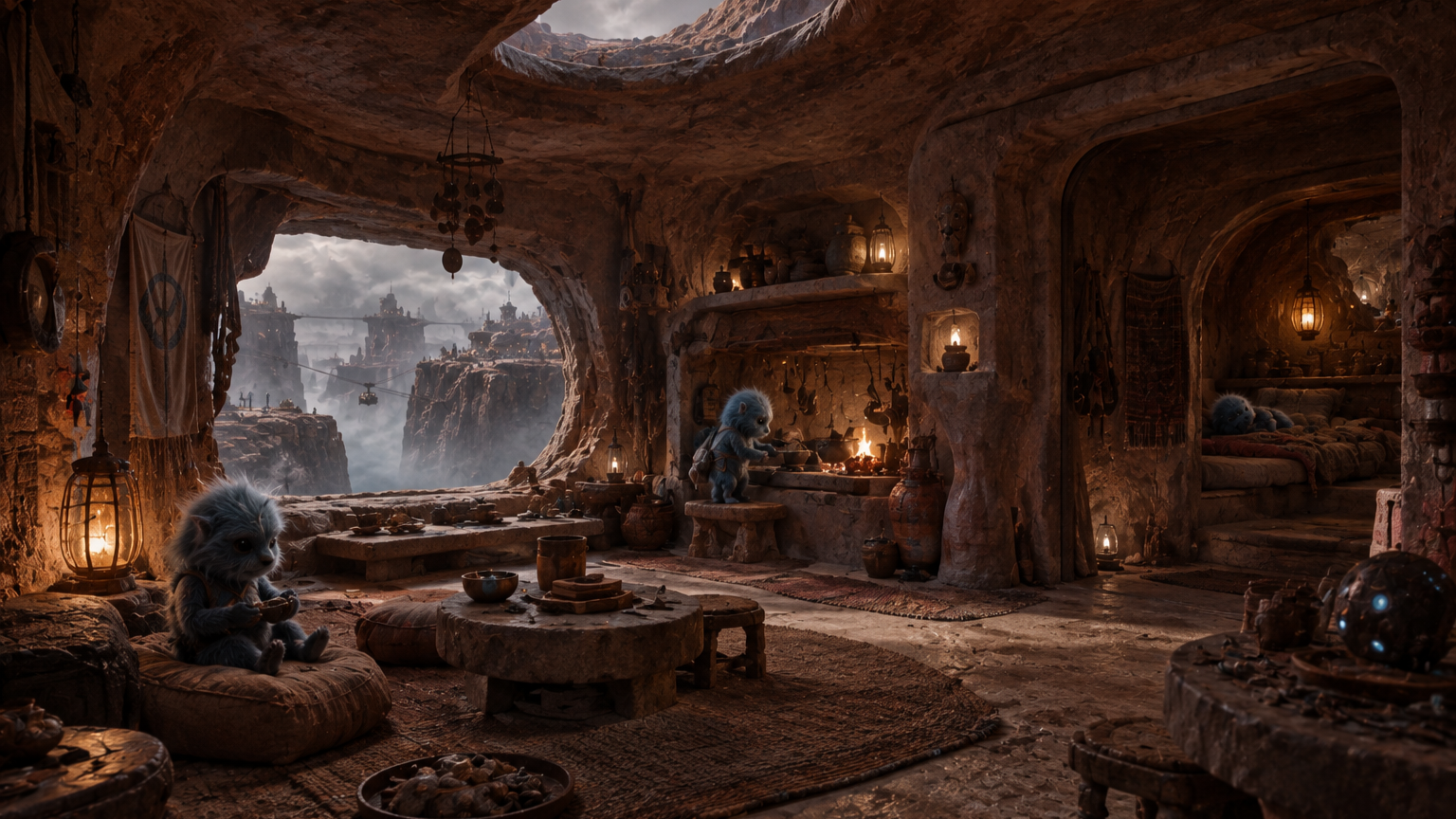
The landscape is dry, barren, and almost entirely without vegetation. Grey-red stone dominates the terrain, forming rough islands of habitable land separated by deep, dangerous chasms. The houses are carved from and built with the same native rock, making them appear almost fused with the planet itself. From a distance, entire settlements seem less constructed than excavated from the cliffs.
Movement across this world is shaped by necessity.
With roads impossible and vehicles impractical, the inhabitants rely on narrow suspended bridges, walking paths, skateboards, and cable-car systems to travel from one rock island to another. These delicate connections form a web across the broken landscape, turning simple movement into a constant negotiation with height, instability, and toxic air below.
The planet is inhabited by small, fluffy blue creatures whose softness creates a striking contrast against the harsh environment around them. Despite the severity of their world, their settlements feel lived-in and communal. Warm interior lights glow from stone openings, small paths connect neighboring homes, and bridges become social spaces as much as infrastructure.
The architecture stays close to the ground. Travel remains light and flexible. Communities spread horizontally across isolated rock islands rather than vertically toward the sky. Every element of life has evolved around one simple truth: the planet may shift again at any moment.
Yet within that instability, the inhabitants have created a world that is connected, warm, and deeply alive.
A fragile civilisation suspended above the clouds — constantly moving, constantly rebuilding, and always beneath the shadow of something far greater than itself.